RFPGPT

RFPGPT produces state-ready RFPs that align requirements, architecture, and compliance into a single, defensible package—without months of writing and reviews.
Get started now
Get started now
Overview
RFPGPT automates the creation of complete, defensible, state-compliant Requests for Proposal (RFPs)—turning months of procurement work into days. It ingests your program’s documents, goals, and constraints to produce clear requirements, aligned architecture, evaluation tools, and audit-ready procurement packages.

Instead of scattered documents, slow drafting cycles, and high protest risk, RFPGPT delivers a structured, repeatable procurement process built specifically for government modernization initiatives.
Key Features:
  • AI-Generated RFP Packages: Automatically produces full RFP drafts—including SOWs, requirements baselines, evaluation criteria, scoring tools, and onboarding packets—grounded in your agency’s policies, architecture standards, and compliance rules.
  • Architecture-Aligned Requirements: Extracts and normalizes FR/TR/NFR requirements from large artifact sets (APDs, audits, process maps, legacy RFPs) and ties each requirement back to outcomes, capabilities, and architecture models for full traceability.
  • Unified Procurement Workspace: Brings program, IT, procurement, legal, and evaluators into a single collaborative environment with shared editing, redlines, approvals, version control, and governance history.
  • Full Lifecycle Automation: Supports the entire procurement journey—from vision framing → requirements → RFP blueprints → vendor Q&A → addenda → evaluation → award → onboarding—within a single canonical workflow.
Start now
Start now
RFP Lifecycle
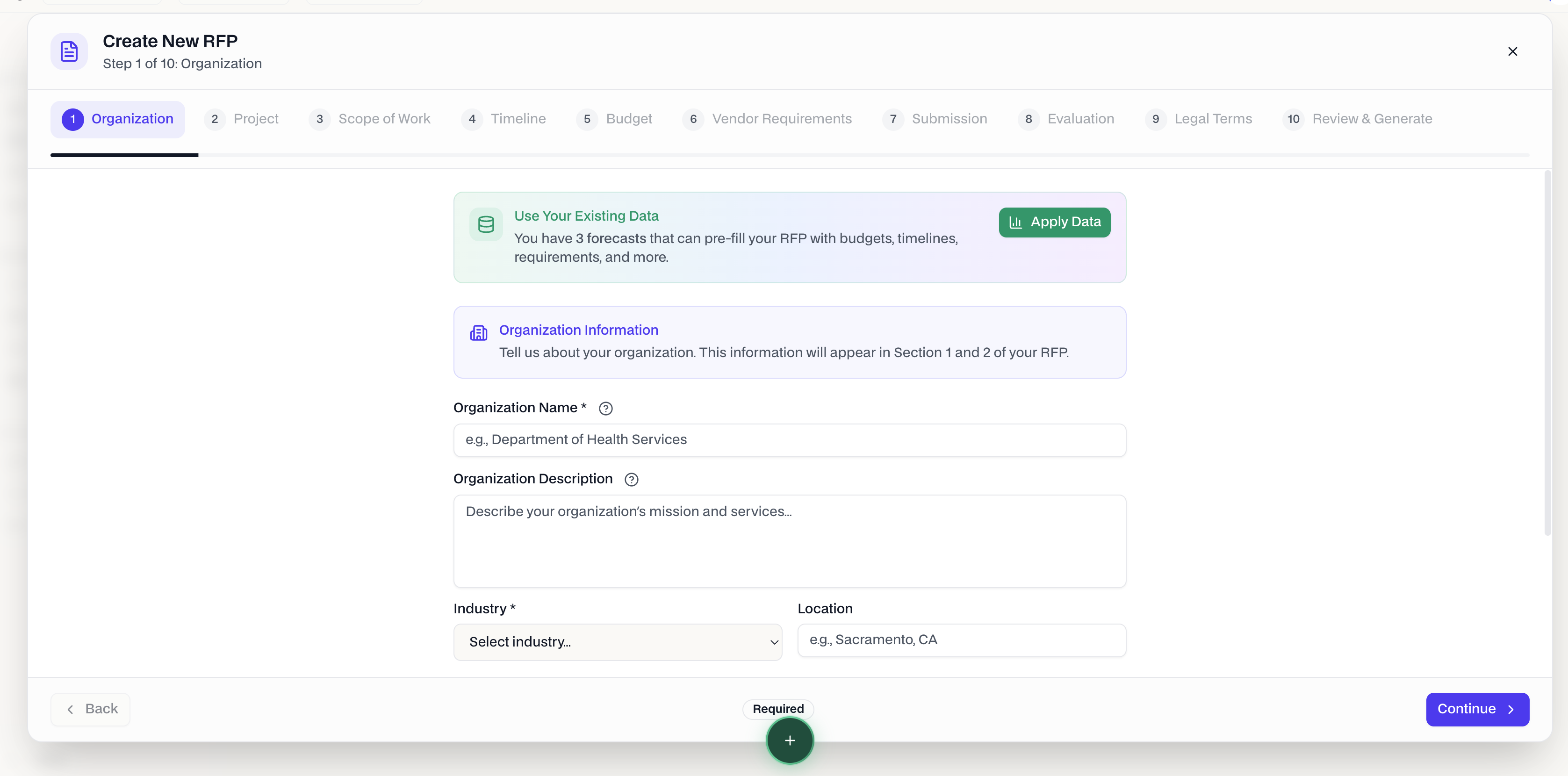
Instead of starting from a blank page, RFPGPT walks your team through a disciplined, nine-phase procurement lifecycle designed specifically for digital transformation initiatives. Each step turns inputs—vision, documents, interviews, requirements, and architecture—into structured, traceable outputs that move the RFP forward with clarity and control.
What the process looks like:
  • Collects your vision, artifacts, and legacy documents to establish context and automatically build the foundation of your RFP—problem framing, outcomes, scope, and initial requirements.
  • Extracts and structures your requirements (FR/TR/NFR) from interviews, APDs, past RFPs, audits, system inventories, and standards—and aligns them to outcomes, risks, and target architecture models.
  • Generates full RFP drafts—including SOW sections, deliverables, evaluation criteria, pricing templates, and compliance language—using your agency’s policies and procurement rules.
  • Supports collaborative review cycles so teams can refine sections, reconcile redlines, manage comments, and maintain version control inside one unified workspace.
Start now
Start now
40–60%
Reduction in procurement timelines
100%
Traceable requirements → architecture → evaluation → award
9 Phases
Complete automated procurement lifecycle
“We’ve replaced three other tools with Prospect.”
Meet our Customers
Meet our Customers
Architecture & Ecosystem
RFPGPT is built on the CADET Platform’s modular, multi-app architecture, combining the OrgVoice knowledge layer, the Transformation Language Model (TLM), and the RFP Engine. It connects directly to your existing systems, identity providers, architecture tools, and document repositories to create a seamless, secure RFP workflow. It works alongside your procurement, architecture, and collaboration tools—no new infrastructure required.
Examples:
  • Integrates with enterprise identity systems (AD, Okta, SAML, MFA) for secure authentication, RBAC, and single-sign-on across procurement, IT, and program teams.
  • Connects to your agency’s knowledge ecosystem by ingesting documents from Confluence, SharePoint, legacy RFP repositories, APDs, architecture diagrams, audits, and system inventories—structuring them automatically through OrgVoice.
  • Links directly with enterprise architecture tools and models through CADET’s modeling workspace (ReactFlow), enabling capability maps, integration diagrams, and target architecture narratives to drive requirement and SOW generation.
  • Works hand-in-hand with other CADET service packs like APDGPT, Estimation, System Landscape, and RespondNow to unify planning, procurement, evaluation, and onboarding in a shared environment.
Start now
Start now
Document secured
Sent for approval
Security & Compliance
RFPGPT is built on the CADET Platform’s zero-trust, government-grade security architecture. Every requirement, document, decision, and draft is protected with encryption, strict role isolation, and full audit logging. The platform aligns with state procurement integrity rules, federal APD guidance, NIST AI governance models, and enterprise security standards—ensuring every action in the RFP lifecycle is traceable, reviewable, and defensible.

Protected by FedRAMP-aligned infrastructure and SOC 2 Type II practices, RFPGPT ensures procurement-sensitive materials stay secure while maintaining the transparency required for legal, fiscal, and federal oversight.
including:
  • Role-based access control and MFA/SSO integration through Clerk, Active Directory, Okta, and SAML—ensuring procurement, program, IT, and evaluator roles stay cleanly separated.
  • Comprehensive audit trails and immutable version history for procurement defensibility, governance logs, and required oversight documentation.
  • Alignment with federal and state standards, including FedRAMP Moderate patterns, SOC 2 Type II, NIST AI RMF, CMS/FNS APD guidance, and WCAG 2.1 AA accessibility.
  • Procurement-integrity protections that prevent cross-vendor leakage, ensure neutral evaluation summaries, and maintain clean separation between solicitation and evaluation activities.
Start now
Start now
common questions
We’re here to help you understand RFPGPT.
RFPGPT evolves with your organization—learning from your documents, architecture, and requirements to help your team produce clearer, faster, and more defensible RFPs. It gives agencies the capacity of a much larger procurement operation while keeping your rules, governance, and oversight intact.
Frequently Asked Questions
What types of APDs does APDGPT support?
Chevron down icon
APDGPT supports Planning (PAPD), Implementation (IAPD), Update (UAPD), and Operational (OAPD) APDs. It also imports past APDs, SS-As, RFPs, and project documents to build consistent, reusable content for new submissions.
Contact us
Contact us
How is APDGPT licensed?
Chevron down icon
Licensing is flexible. Agencies can license APDGPT as a standalone product or as part of the larger CADET platform. Options include annual subscriptions, multi-year agreements, or enterprise bundles with other service packs like RFPGPT or ExcelerPlan.
Contact us
Contact us
Where is APDGPT hosted?
Chevron down icon
APDGPT is hosted on U.S.-based, FedRAMP-aligned cloud infrastructure with strict data residency requirements. All information stays within the United States, and no AI training ever uses customer data.
Contact us
Contact us
Does APDGPT require any installation or special hardware?
Chevron down icon
No. APDGPT is fully browser-based and works on standard government laptops and networks. Agencies simply log in via their existing SSO provider (Okta, Azure AD, SAML, etc.) and begin working.
Contact us
Contact us
What kind of support is available?
Chevron down icon
Agencies have access to a secure 24/7 support portal, onboarding sessions, documentation, and training resources. Priority support is available for enterprise deployments or resellers working with multiple states.
Contact us
Contact us
Can APDGPT help us track performance or update APDs over time?
Chevron down icon
Yes. APDGPT includes dashboards, document history, and performance tracking to monitor cost, timeline, staffing efficiency, and progress toward APD outcomes. This makes updates and reporting far easier than manual tracking.
Contact us
Contact us
Will APDGPT continue to evolve?
Chevron down icon
Yes. The platform is built to expand with new service packs, API integrations, collaboration features, and AI capabilities. APDGPT already integrates with the broader CADET ecosystem, and future releases will add deeper automation for procurement, performance management, and governance.
Contact us
Contact us
What does a reseller get with the APDGPT reseller program?
Chevron down icon
Resellers get discounted licensing, co-branded collateral, access to demo environments, and priority support for sales and delivery. Because agencies using APDGPT have seen up to an 80% reduction in APD development time and over 400 staff hours saved on a single APD, you’re walking in with a very tangible value story for procurement and modernization deals.
Contact us
Contact us
How does APDGPT fit into my existing services?
Chevron down icon
APDGPT fits neatly alongside strategy, enterprise architecture, PMO, MITA work, and system integration. You can use it to accelerate APDs you’re already writing, bundle it with transformation roadmapping, or anchor a broader “AI-enabled planning and procurement” offering.
Contact us
Contact us
Do I need a deep APD or CMS background to sell this?
Chevron down icon
No. APDGPT bakes the structure, checklists, and compliance guardrails into the product. You need to understand the problem agencies face and how the tool solves it; the detailed APD and CMS language is generated and guided inside the platform.
Contact us
Contact us
What kind of onboarding support do resellers receive?
Chevron down icon
Cadet provides enablement sessions, demo scripts, sample APDs, positioning guides, and help on early sales calls. For bigger pursuits, we can co-present with you to shape the offering, address technical questions, and align APDGPT to the state’s roadmap.
Contact us
Contact us
Is there a clear ROI story I can share with clients?
Chevron down icon
Yes. In addition to the time savings, a state deployment of the broader CADET platform (with APDGPT as a core component) projected around 85% ROI within three years and over $1.2M in annual efficiency gains by reducing outsourced APD/RFP work and eliminating rework.
Contact us
Contact us
How much technical work is required from my team?
Chevron down icon
Very little to get started. APDGPT runs as a secure, hosted solution with SSO and basic configuration handled during onboarding. Deeper integrations (SharePoint, Teams, EA tools, Jira, etc.) can be added as upsell services if you or the agency want them.
Contact us
Contact us
Can I bundle APDGPT with other Cadet products?
Chevron down icon
Yes. Many resellers position APDGPT together with RFPGPT (RFP generation), RespondNow (vendor response automation), and ExcelerPlan (cost and benefit modeling) to cover the full lifecycle from planning through procurement and performance. This creates larger, stickier engagements and multi-year revenue instead of one-off projects.
Contact us
Contact us
How does RFPGPT learn our program?
Chevron down icon
RFPGPT ingests your existing materials—APDs, past RFPs, audits, system inventories, architecture diagrams, policies, and process maps—and organizes them through OrgVoice, creating a structured knowledge base unique to your agency. It then uses this information to guide every stage of the RFP.
Contact us
Contact us
What types of RFPs can RFPGPT generate?
Chevron down icon
RFPGPT is designed for digital transformation and modernization procurements: MMIS, eligibility, UI/DI, child welfare, SNAP/TANF, DMV modernization, cloud migration, data platform modernization, SaaS adoption, integration modernization, and system replacements.

Contact us
Contact us
Does RFPGPT replace procurement or evaluation teams?
Chevron down icon
No. RFPGPT supports—not replaces—procurement, legal, IT, and evaluation staff. It automates drafting, alignment, version control, Q&A responses, scoring tools, and summaries, while decisions and scoring remain entirely human-driven.
Contact us
Contact us
How does RFPGPT help reduce protest risk?
Chevron down icon
RFPGPT produces consistent language, complete requirements, clear evaluation criteria, and full traceability from outcomes → requirements → evaluation → award. This transparency strengthens defensibility and reduces ambiguity that often leads to protests.
Contact us
Contact us
Can RFPGPT work with our existing tools?
Chevron down icon
(SharePoint, Confluence), architecture models, and CADET’s other service packs (APDGPT, System Landscape, RespondNow). It exports to PDF, DOCX, XLSX, XML, JSON, and more.
Contact us
Contact us
Is RFPGPT secure and compliant for government use?
Chevron down icon
RFPGPT uses a zero-trust architecture with encryption at rest and in transit, RBAC, MFA/SSO, and full audit logging. It aligns with FedRAMP Moderate patterns, SOC 2 Type II controls, NIST AI RMF, CMS/FNS APD guidance, and state procurement integrity rules.
Contact us
Contact us
How does RFPGPT ensure consistency across large, multi-year modernization efforts?
Chevron down icon
RFPGPT standardizes the entire procurement lifecycle using a repeatable nine-phase process, structured requirements models, and architecture-aligned templates. It maintains a persistent knowledge base across years of documents, decisions, and updates—ensuring consistency even when staff, vendors, or priorities change.
Contact us
Contact us
Experience a faster, smarter way to build RFPs.
No more scattered requirements, unclear sections, version confusion, or last-minute rework. RFPGPT brings every part of the procurement process into one clear, guided flow.
Meet RFPGPT
Meet RFPGPT